Overview
Four kernels implemented from scratch in a single CUDA translation unit.
Each kernel launches with a block-strided pattern — threads
stride across the problem in blockDim.x * gridDim.x steps so any
problem size maps onto a fixed grid. Data reuse is squeezed out with
register tiling (Tn, Ti, Tx,
Ty) sized to keep working sets inside the L1/L2 caches, and every output
passes through a ReLU. The two convolution kernels differ in which axis
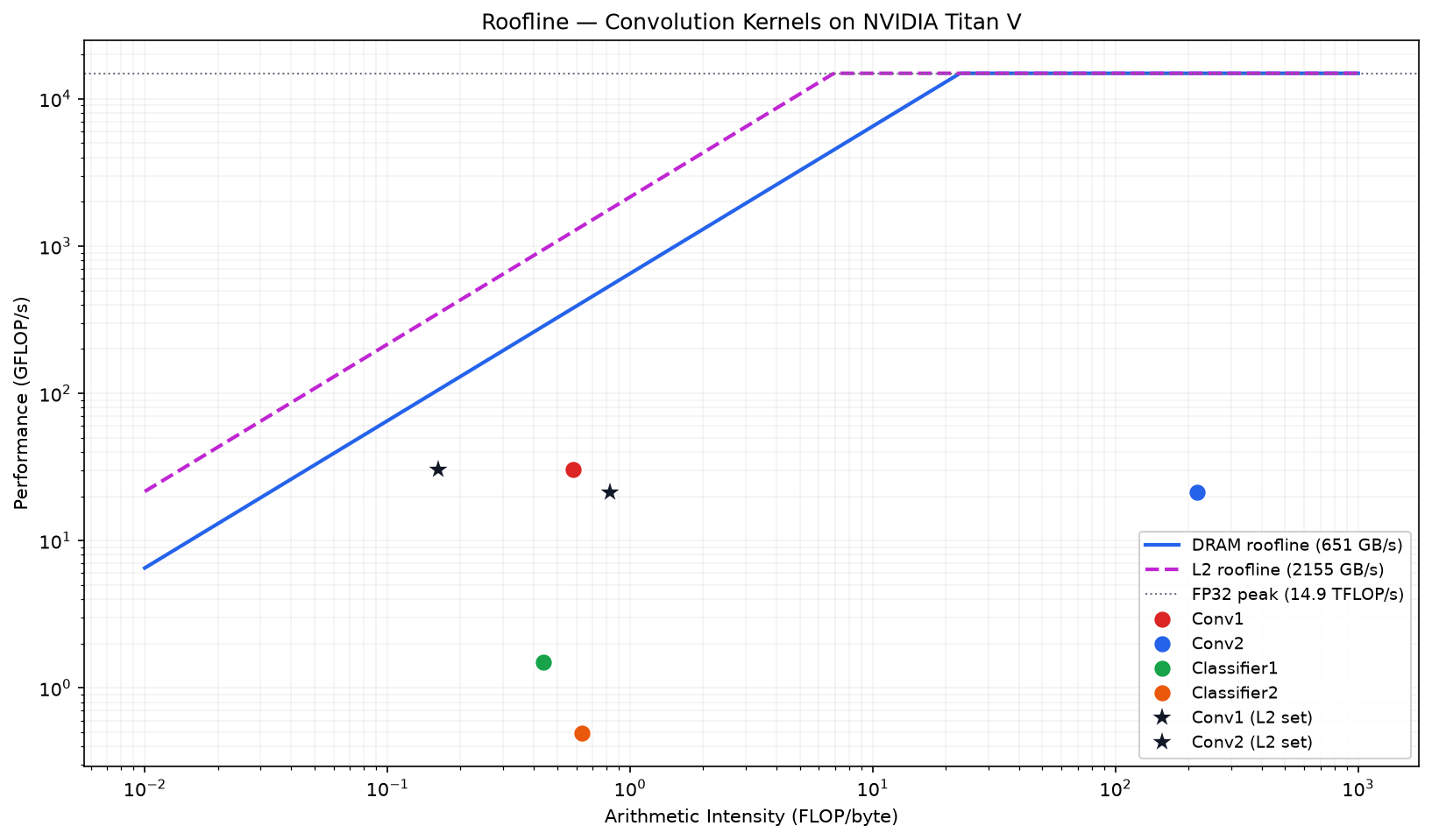
they stride over — the key idea behind their very different roofline placement.
The kernels
Two convolutional layers and two fully-connected classifiers.
Conv1 3×3, 224², 64→64
Strides over the spatial (y, x) dimensions. Large feature maps, modest channel count. Non-contiguous access hurts reuse → low arithmetic intensity, memory-bound.
Conv2 3×3, 14², 512→512
Strides over the channel (n, i) dimensions instead. With many feature maps this yields far better reuse → much higher arithmetic intensity on the roofline.
Classifier1 25088 → 4096
Fully-connected layer as a tiled matrix–vector product with ReLU. Threads
strided over the output dimension, input tiled by Ti.
Classifier2 4096 → 1024
The smaller fully-connected layer, same structure — the cheapest of the four kernels to evaluate.
Results
Batch size 1 on the NVIDIA Titan V — our naive kernels vs. CuDNN.
| Kernel | Ours (ms) | Ours BW (GB/s) | CuDNN (ms) | CuDNN BW (GB/s) | Slowdown |
|---|---|---|---|---|---|
| Conv1 | 121.34 | 52.34 | 0.342 | 406.34 | ~355× |
| Conv2 | 43.677 | 0.097 | 0.186 | N/A | ~235× |
| Classifier1 | 134.51 | 3.43 | 0.746 | 542.32 | ~180× |
| Classifier2 | 17.268 | 0.77 | 0.040 | 416.23 | ~430× |
What the numbers say
- All four kernels are memory-bandwidth bound — they sit well below both roofline ceilings, with too little data reuse (no shared-memory scratchpad).
- We trail CuDNN by roughly 100×: it uses the Winograd algorithm on tensor-core matrix multiply, which a naive direct convolution can't match.
- The large block size left only 49 of 80 SMs worth of blocks occupied, leaving performance on the table.
Roofline model
Where each kernel lands relative to the Titan V's DRAM and L2 ceilings.
python perf/roofline.py.Mechanistic performance model
A separate model (Mini-Project 2) predicts operational intensity from the tiling parameters at each level of the memory hierarchy. Sizing tiles so the working set fits the L2 (4.5 MB) and L1 (65 KB/SM) caches gives target intensities of 14.05 FLOP/byte for Conv1 (L1 set) and 34.37 FLOP/byte for Conv2 (L2 set).
Build & run
Needs the CUDA Toolkit (nvcc). Makefile defaults to SMS=70.
cd src
make                             # builds ./convolution
./convolution -k Conv1 -b 16     # kernel + batch count

# kernels: Conv1 | Conv2 | Classifier1 | Classifier2
make profilePerformance          # nvprof timing
make profileMemory               # nvprof -m dram_read_throughput
Reports & artifacts
Full write-ups and raw profiling data.